A customer testimonial series, filmed in their customers' world… that doesn't feel like a testimonial.
Honest and raw on the surface. Polished underneath.
Scroll ↓
01 · The Ask
What we heard from Alex
A loyalty software company wants customer testimonials filmed where their customers actually are… the UAE, across the US, Canada, LATAM, Europe, Asia. It has to look enterprise. Netflix documentary setup, amazing b-roll. Quality first, no corners cut.
And you need three things: how we'd price it, whether we're free through the end of the year, and proof we can do customer interviews at this level. All three are in here.
02 · The Question
Can we make customer testimonials that feel honest and raw, keep the polish and sophistication, and leave the viewer feeling they haven't seen a testimonial done this way before?
That's the question this whole proposal is built around.
Our thesis: most testimonials get skipped in the first five seconds, and production value doesn't fix that. A beautifully lit, boring interview is still boring. What keeps people watching is knowing what's worth putting on camera in the first place… and then not overproducing it.
The Netflix docs everyone points to (Drive to Survive, Full Swing) aren't overproduced. They're well lit, well recorded, and real. That's the bar.
03 · The Idea
Nobody sits in a chair in front of a logo wall.
The customer talks while doing something real from their day. The interview happens inside the routine, not instead of it… and the product shows up where it actually lives.
The look: lit well, one soft source when the scene needs it, real locations, camera work that feels expensive. But nothing staged.
And a lot of b-roll. The retail floor, the gate, the kitchen, the customer in it. The interview is the spine. The place is what makes it feel like a real company and not a testimonial.
If it feels produced, we've lost the raw part. If it looks cheap, we've lost the enterprise part. The whole job is holding both.
Alok, on camera · 2:58
What makes a good ad… and why this series gets built the same way
This isn't a sample, it's the thinking. Five rules on what makes an ad interesting, filmed on a walk through Washington Square Park. The short version: an ad isn't there to sell, it's there to make the brand interesting… and that takes an energy you can't force. Every testimonial in this series gets built from that place.
Storyboard
One formula, twenty customers. The shape of every film.
Six beats, about two minutes. The buildup, the question, the reveal, the person in their world, the proof, the close. Sketched across the client's industries so you can see it land anywhere. Every customer gets their own version of this.
01 · The buildup · 0:00
Ten seconds of their world before anyone speaks. A pass at the dinner rush, a gate at boarding, a floor at opening. Fast, big, real. The music is already going somewhere.
The shot: six to eight cuts, none longer than two seconds. Gimbal moves, tight details, one wide. All of it from day one.
02 · The question · 0:10
Everything stops. One line, the one the whole film answers. Said by the executive, or set as a title over a held frame. The viewer leans in.
The shot: a locked-off medium, held three to four seconds. Music drops to almost nothing. Then the cut.
03 · The reveal · 0:15
The answer starts with the place. A wide you've never seen a software company show: the floor, the light, the scale of what they actually run.
The shot: the widest lens we carry, from height. One slow move, six seconds. Natural light, shaped. This is the frame that says big.
04 · The environmental portrait · 0:20
Now the person. The executive in a real chair, in their real building, talking about the thing they actually run. Soft light from one side. A little shadow. They're in it, living it.
The shot: two cameras, one tight, one loose. Window as the key, the gaffer shaping it. Day two. The interview carries the film from here.
05 · The proof · 1:00
The product, where it lives. Not a screen recording, not a dashboard. A phone at a gate, a points balance at a counter, a name remembered at a desk. The claim from the interview, shown.
The shot: handheld, close, real customers and staff. The b-roll from day one cut against the interview from day two. Thirty seconds of this, with the music back up.
06 · The close · 1:45
Then it goes quiet. The widest shot again, the light gone soft, the last line from the interview over it. The one they'll remember. Then the name.
The shot: locked off, eight seconds, let it breathe. The music resolves. End card. Cut.
04 · How It Gets Made
We build the creative framework, then the energy to propel the series to success… here's how.
The story process and the direction are the constant. They carry from the first shoot to the last, so every testimonial is seamless with the next one and the whole series stays on brand and on theme. That's what the money is for.
The phases
Phase one · the US customers
Before the end of the year. We go to the US customers first, build the formula on the first one, and every customer after that gets it faster and tighter.
The client is targeting five films a month. That's the pace we're building for. Before we commit to a number, the four of us set the expectations together: what each film has to do, and how much time we get with each customer. That protects the client as much as it protects the work.
Phase two · everywhere else
The formula gets built with the US customers first. Once it's set and working, we take on the international production: we fly where it makes sense, and for the far cities we direct a local crew on the ground to the same plan and the same look.
Either way the client has one team to call, and every film in the series still belongs to the others. We scope it with you then, with real numbers.
Phase three · the product films
You mentioned about six product films coming. Same crew, a different job. We'd rather be the one team for all of it than hand you a second vendor to manage.
But one thing done properly before the next one starts. We'd scope those once the testimonials are running.
1
First · with you and the client
Pre-production
One call, the three of us and the client: what these films need to do. A series built to win the first ten seconds with a new prospect gets shot differently from a series built for volume. We want to know which one it is before we plan a single day.
Then which customers, where, and what each one's story actually is. A storyboard and a shoot plan for every customer, signed off before anything is filmed. Changes on paper are free. Changes on site are not.
2
Every city · two crew sizes
Lightweight, but premium.
Two crew sizes. Both have the same baseline quality. What changes is how much we can make in a day, and how complex the shots can get.
The $10K crew
Alok directs and runs sound. Hannah runs cameras and the production. A local gaffer in every city, added at cost, so the light is right.
Two people who've shot together, plus one local who knows the light. Small footprint, fast to adapt on the day, and most of the budget goes to the two days with the customer instead of a crew list. This is how most of the work in section 05 was made.
The $20K crew
Every role has its own person. Alok directs. Hannah produces. A local DP with a cinema package, a dedicated sound recordist, a local gaffer, more light, better glass.
More made in every day, and room for the complex shots. The polish in the reference videos. For the customers the client wants to lead with.
Either way: same director, same plan, same look in every city.
3
Two days · every customer
The shoot
Day one is the place. We go where the customer's world actually happens, the floor, the counter, the gate, the kitchen, and shoot the b-roll with the customer in it. Camera on a gimbal, Alok directing them through their own day. That footage is what makes the film look like them and not like a studio.
Day two is the people. Two or three executives, interviewed inside the environment we shot on day one, lit softly, with time to get the line that matters. Then we're out.
Always two days. One day is possible and we've done it, but it means hoping nothing moves. Two means the plan survives a rescheduled executive, a weather day, or a better location we only find once we're there.
4
After · post
The edit, and the QC gate
We cut it. Everything synced, organized, colour-corrected, audio cleaned. One hero film per customer, around two minutes, the length the marketing side of this actually needs. Then the sales kit from the same shoot: the ad cut, the prospect cut, the social cut, priced per cut.
Nothing goes to the client without a QC pass: audio levels and stereo, captions, music licensing, clean cuts. The boring stuff that makes enterprise clients trust you.
And once three or four customers are in the can, there's a compilation waiting to be made: every customer in their world, one big question, the cuts. The hero piece for whatever campaign comes next. It costs almost nothing extra because the footage already exists.
1plan per customer, signed off
2of us on every shoot
2days, every customer
1look, every city
05 · Proof
You asked for our best customer interviews. Here's the direction we'd take… and what we'd add on top.
Live · wall-of-stories.pages.dev
The Wall of Stories
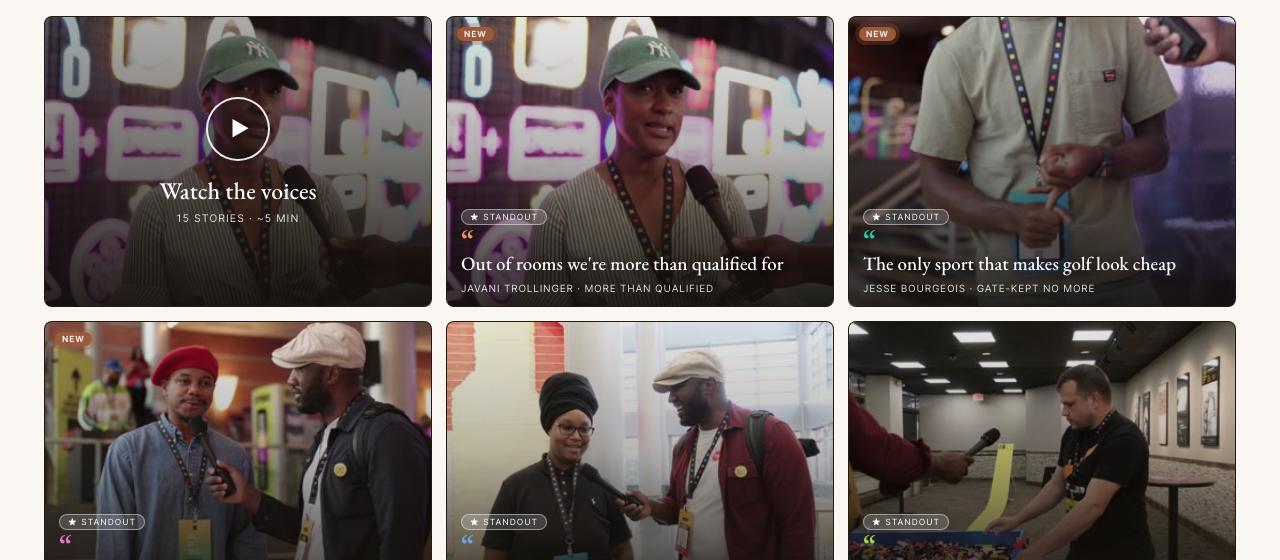
Black Tech Week, Cincinnati 2026. A pilot for a client: fifteen people, thirty-eight stories, one roaming crew on a conference floor, one day, no lights. Tap a face, hear the person.
It's not the finish this series needs. It is the direction. Raw, organic, vibey… people talking about something they care about, in the place it happened. This series takes that feel and adds the part a conference floor can't give you: the light, the sound, the time. Open the wall
If the client wants a straight compilation cut instead of a wall, say the word… it's an afternoon.
Urban Sites · environmental b-roll
Court Street
No interview in this one. A live construction site, hard hats on, and the place telling the story by itself.
Allegiant Pilots · two-person crew
The CVG picket line
A sophisticated look from a crew of two. One morning, no second takes, shot as it happened.
Cincy Social · interview reel
How we shoot an interview
Setups from the last two years: the light, the lens, the room.
06 · Who's On This
Alok Karnik
Director. Runs the interview and the sound. You've worked with him on CashFlow Kings, CCW Las Vegas, and the Pendleton shoot for Akash.
Cameras and visual direction. Commercial and creative photo and video background… composition, framing, lighting, styling, wardrobe, the set itself.
Also the production manager on this: project management certificate, has run corporate and creative projects end to end, PA experience on multiple film sets, and an event coordination background. The person who makes sure a shoot in Toronto and a shoot in Dubai feel like the same production.
Availability · your question #2
Open now through the end of December. Nothing on the calendar that blocks travel. Give us dates and we'll hold them.
07 · Why Us
Why hire us instead of piecing it together shoot by shoot.
The other way to do this is a different local crew in every city. Each one briefed from scratch, each one with its own idea of what big looks like. It can work. It's also twenty chances for the series to stop looking like one series.
You only get one shot to get this right
You rarely get to “redo” a customer testimonial. There's one shot to nail this. That's where we excel.
One team, one plan, one take.
We've already done this with Alex
Three jobs together: CashFlow Kings, CCW Las Vegas for 1Point1, the Pendleton shoot for Akash. We know how Alex ideates, how he gives notes, what he means when he says big.
A new crew in every city has to learn all of that, twenty times. With us it's already learned. That's the friction that quietly eats a series like this.
You've caught us at a particular moment
Cincy Social has moved past the videographer level, and past the DP level, to directing and producing a feeling. Someone who can hold the look, the sound, and the story of a film in their head at the same time. That's not an easy thing to find. At this rate, it's rarer.
AI can generate any aesthetic now. It can't be in the room. That's the part you're hiring.
Reliability you can check
No cancelled shoots. No client we'd be nervous to have you call. Shoots that land on the day they were planned, with the footage they were planned for.
Ask for references and we'll send a list, not a quote card. Call any of them.
08 · Investment
Priced per customer. Two crew sizes, one formula.
Every number here is one customer: two days on site, the film edited and delivered. The crew size is chosen per customer, so the client can run most of the series at $10K and put the $20K crew on the ones they want to lead with. Travel sits on top at cost, quoted before anything is booked. Nothing here is a quote yet… the real numbers land once we know which customers and which cities.
The $10K crewAlok and Hannah, two days
$10,000 PER CUSTOMER, PLUS TRAVEL
Creative development and the shoot planThe idea above, turned into a storyboard for this customer. Built with you and the client, signed off before anything is filmed.
STEP 1
Two days on site. Alok and Hannah.Day one is the place: the b-roll, the customer in their world. Day two is the interviews, two or three executives. A local gaffer joins both days, added at cost below.
STEP 2–3
Camera, lenses, premium audioOur kit, included. One cinema camera and lenses, the mics and recorder. Lighting is rented on site, through the gaffer.
STEP 3
The editSync, organization, backup. The hero film cut, coloured, audio cleaned. One round of revisions.
STEP 4
This is the honest floor for work at this level. It won't be the Tesla video. It will be very good, in the customer's real world, and it will look like the rest of the series. It's how most of the work in section 05 was made.
The $20K crewFull crew. The Tesla level.
from $20,000 PER CUSTOMER, PLUS TRAVEL
Everything in the $10K crew, plus a local DP with a cinema package, a dedicated sound recordist, the gaffer, more light, better glass. This is what the polish in those reference videos actually costs. Same two days, more made in each of them, and room for the complex shots. Pick it per customer… the ones the client wants to lead with.
On top, at cost or as needed
Quoted per city before anything is booked, so the client always knows the number first.
A local gaffer and the lighting rental, per shoot day, at cost. The gaffer usually runs $600 to $1,200 depending on the city. Both crew sizes.
Travel, lodging, and per diem for two, at cost.
An additional shoot day, $2,500. Additional hours on a shoot day, $350 an hour.
Additional cuts from the same shoot: the ad cut, the prospect cut, the social cut. Priced per cut once we know which ones the client will actually use.
An additional round of revisions, $500.
Hair and makeup on set, $500 a day.
Rough planning number: five customers at $10K is about $50,000, plus the gaffer and travel. One $20K customer costs about the same as two at $10K.
For scale
Our numbers next to what this work usually costs
Market ranges are published 2026 rates for professionally produced work in the US. Bigger cities run higher.
Item
This proposal
Market range
Base, per customerThe $10K crew. Two shoot days, Alok and Hannah, edited.
$10,000
$10,000 – $30,000two shoot days, before editing
Higher end, per customerThe $20K crew. Two shoot days, full crew, edited.
from $20,000
$10,000 – $30,000two shoot days, before editing
Additional crew, per dayGaffer, sound recordist, director of photography.
at cost
$600 – $3,000per person, per day
Two days of production at market rates is $10,000 to $30,000 before anyone edits a frame. Our base is the bottom of that, with the edit in.
Ranges from Vidico's 2026 testimonial and production cost guides, Assignment Desk's 2026 crew rates, and NeedaCrew's 2026 day-rate guide.
Each customer is its own job. Half to hold the dates, half when the film is delivered.
Travel billed as incurred, net 15. Or booked directly on the client's card, whichever is easier for their accounting.
One round of revisions per film is included. Sign-off on the shoot plan is what keeps revisions rare.
Cincy Social retains original copyright of all original footage and creative assets. The client receives an unlimited, perpetual license to use all delivered content across social media, the web, advertising, and any other platform. If this goes out under Pipeline Road's name, the license passes through to your client the same way.
Music licensed from the Artlist library. Full terms in contract.
09 · What Happens Next
You wanted this by Thursday. Here's how the rest of the year could go.
Thursday
This goes to you. You take it to the client.
When it's a yes
One call, the three of us and the client. What the films need to do, which customers, which cities, what the product actually does for them.
Two weeks later
Storyboards and shoot plans, one per customer. Signed off before anything is filmed.
As early as mid-October
First shoot.
Through December
The rest of phase one, the US customers. Then we sit down and scope the rest of the world.
What we'd need to turn the rough number into a real one
Which customers, and which cities.Phase one is the US ones. Travel is quoted per city.
Which customers get the full crew.The $20K crew on the ones the client wants to lead with. $10K on the rest.
How many cuts per customer the client will actually use.The hero film is in. The ad, prospect, and social cuts get priced per cut.
Does the client know who's producing, or does this go out under Pipeline Road?Either works. It changes the paperwork, not the work.
If this is the right direction, send it on and let's get the three of us on a call.